
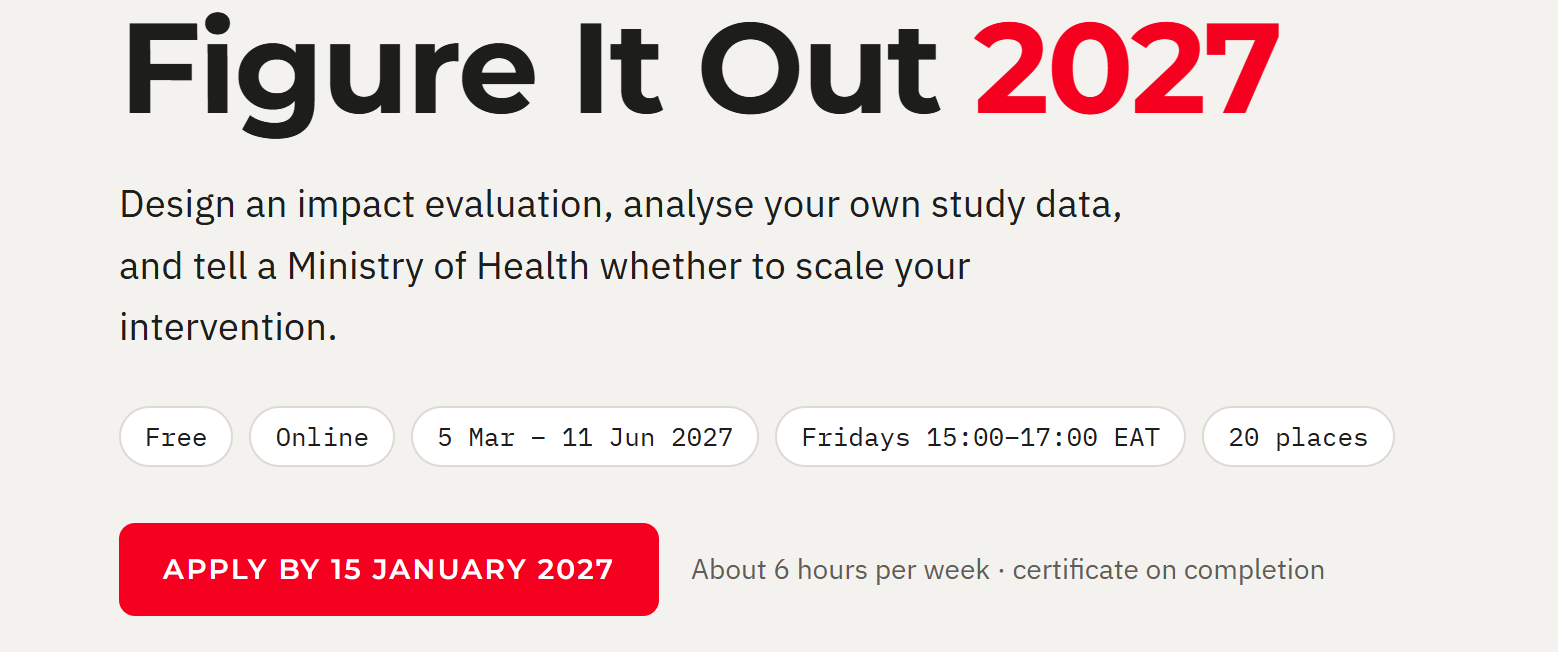
Figure It Out 2027
About the course
One policy question, from design to advice
Figure It Out (FiO) is a free, online, 15-week course in which you design, analyse and defend an impact evaluation of a health intervention you invent yourself. It is offered to researchers in the East African Consortium for Clinical Research (EACCR) network by the Amsterdam Institute for Global Health and Development (AIGHD – Amsterdam UMC).
FiO started in 2020 in the Research Master in Global Health at Vrije Universiteit Amsterdam. In 2024 it expanded to EACCR, and 2027 is the third EACCR round. The whole course is built around one question:
Can decentralising hypertension care reduce blood pressure among people with elevated or high blood pressure?
Each group picks a country, designs an intervention to answer that question, and in the end advises that country's Ministry of Health whether to scale it up.
Learning objectives
By the end of the course you can
- Draft a quantitative research proposal for a specific health policy question
- Choose and justify an impact evaluation design (randomised or quasi-experimental)
- Apply basic and advanced quantitative analysis techniques in R, Stata or Python, including difference-in-differences, multilevel models and methods for missing data
- Summarise the findings of a quantitative analysis
- Write a brief advisory report based on those findings and other available evidence
- Present quantitative findings to an expert audience
Who should apply
Researchers at EACCR member institutions
The course is for early- and mid-career researchers at EACCR member institutions in the Democratic Republic of the Congo (DRC), Ethiopia, Kenya, Rwanda, Sudan, Tanzania, Uganda and Zambia who want hands-on experience with impact evaluation.
Prior knowledge
Basic statistics (regression, hypothesis testing). You do not need prior experience with impact evaluation methods.
Software
A laptop with R or Python (both free) or Stata installed, and a stable internet connection for live online sessions.
Time commitment
About 6 hours per week: a 2-hour live session, group work and, from May, a 1-hour consultation.
Group size
Places are limited to 20 participants, so we can give each group close supervision.
Supervisor support
Your supervisor or line manager should agree to the time you will spend on the course.
The course is free of charge.
Format and schedule
Live online, every Friday
All sessions are live online from 5 March to 11 June 2027. The time stays the same throughout the course.
From the week of 10 May, once you have your dataset, each group gets its own weekly 1-hour consultation with hands-on guidance on the analysis, such as help with coding in R, Stata or Python. We schedule these with each group at a time that suits you, up to the mock presentations on 4 June. In the week of 7 June, each group has a final 30-minute check-in to work through the feedback from the mock. There are no sessions on public holidays in the participating countries.
Nov
Diamonds mark single dates; open orange diamonds mark Fridays without a session. The dashed line is the expert panel on 11 June.
| Date | Session | Lecturer | Assignment |
|---|---|---|---|
| Fri 5 Mar | Course introduction + overview of quantitative study designs | Dr Daniëlla Brals | Readings 1–3 |
| Fri 12 Mar | Trial design + example from Ghana | Dr Guus ten Asbroek | Readings 4–5 |
| Fri 19 Mar | Quasi-experimental designs + difference-in-differences | Dr Daniëlla Brals | Readings 6–7 |
| Fri 26 Mar | No session (Good Friday) | — | — |
| Fri 2 Apr | Survey design + survey weights | Dr Daniëlla Brals | Start protocol e-learning (reading 8) |
| Fri 9 Apr | Study proposal and protocol | To be confirmed | Develop study design |
| Fri 16 Apr | Research budget | Mark van Knegsel | Develop study design |
| Fri 23 Apr | Difference-in-differences in R/Stata/Python | Dr Daniëlla Brals | Peer feedback on another group's design |
| Fri 30 Apr | No session (Ethiopian Good Friday) | — | Study design due Mon 3 May |
| Fri 7 May | Multilevel modelling in R/Stata/Python | Dr Daniëlla Brals | Datasets released Mon 10 May |
| Fri 14 May | Handling missing data + other useful tips for your analysis | Dr Daniëlla Brals | Analysis and brief |
| Fri 21 May | No session (group consultations) | — | Analysis and brief |
| Fri 28 May | No session (national holiday, Ethiopia) | — | Analysis and brief |
| Fri 4 Jun | Mock presentations | Course team | Revise; 30-minute check-in per group |
| Fri 11 Jun | Final presentations to the expert panel | AIGHD expert panel | Brief + analysis code due |
Assessment and certificate
Four deliverables and a certificate
You receive a certificate of completion from AIGHD when you attend at least 80% of the live sessions and your group submits all four deliverables.
| Deliverable | Who | Due |
|---|---|---|
| Study design and analysis plan (2–3 pages) | Group | Mon 3 May |
| Analysis script (R, Stata or Python) | Individual | Fri 11 Jun |
| Analysis and policy brief | Group | Fri 11 Jun |
| Presentation to the expert panel | Group | Fri 11 Jun |
Every deliverable gets written feedback from the course team. The expert panel gives feedback on your presentation and your scale-up recommendation.
Faculty
Who teaches the course
Dr Daniëlla Brals
Course coordinator, AIGHD
Dr Guus ten Asbroek
AIGHD · Trial design
To be confirmed
AIGHD · Study proposal and protocol
Mark van Knegsel
AIGHD · Research budgets
The expert panel consists of at least three senior AIGHD researchers.
Readings
Real evaluations from sub-Saharan Africa
Each reading illustrates the design taught in the session it belongs to.
- Effect of the Newhints home-visits intervention on neonatal mortality rate and care practices in Ghana: a cluster randomised controlled trial Ghana · cluster RCT
- Newhints cluster randomised trial in rural Ghana: trial protocol Ghana · protocol
- Promoting skin-to-skin care for low birthweight babies: findings from the Ghana Newhints cluster-randomised trial Ghana · cluster RCT
- The effect of health insurance and health facility-upgrades on hospital deliveries in rural Nigeria: a controlled interrupted time-series study Nigeria · interrupted time series
- The impact of subsidized private health insurance and health facility upgrades on healthcare utilization and spending in rural Nigeria Nigeria · difference-in-differences
- Can school-based distribution be used to maintain coverage of long-lasting insecticide treated bed nets: evidence from southern Tanzania? Tanzania · survey
- Evaluation of long-lasting insecticidal net distribution through schools in Southern Tanzania Tanzania · survey
- The Global Health Network e-learning: The Study Protocol e-learning · Parts 1 and 2
How to apply
Apply by 15 January 2027
The application form asks for your contact details, institution, country, current position and highest level of education, and a short motivation paragraph (up to 150 words) on why impact evaluation matters for your work.
- 1 Nov 2026Applications open
- 15 Jan 2027Applications close
- 29 Jan 2027Selection results sent
- Week of 22 FebOnboarding and software check
- 5 Mar 2027First session
- 11 Jun 2027Final presentations
Questions


- Log in to post comments